
Connecting Communities: ICT and Mobile Phone Repair as a Ticket to Opportunity
August 25, 2026 2026-08-25 14:31Connecting Communities: ICT and Mobile Phone Repair as a Ticket to Opportunity
Connecting Communities: ICT and Mobile Phone Repair as a Ticket to Opportunity
In every trading centre across Uganda, someone is holding a cracked phone screen, hoping there is a technician nearby who can fix it. That everyday need is quietly becoming one of the country’s most accessible entry points into self-employment.
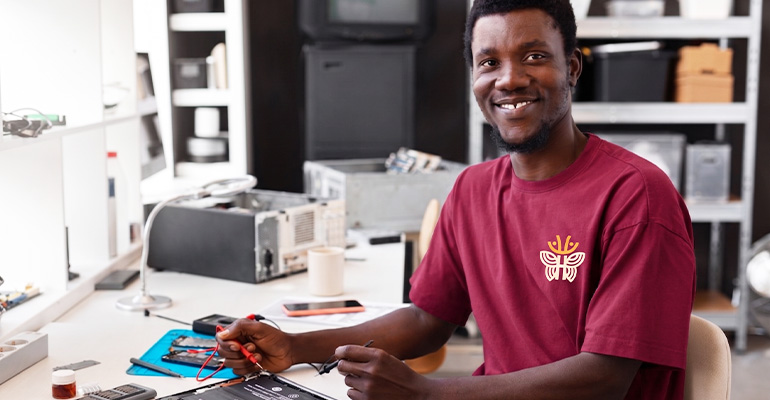
It is easy to think of the digital economy as something distant; a world of software engineers and tech startups in faraway cities. But for most Ugandans, their daily relationship with technology is far more grounded: a mobile phone that needs a new battery, a laptop that will not start, a small business owner who needs help setting up mobile money or basic digital record-keeping. This is the real, everyday digital economy, and it needs skilled local technicians far more than it needs distant software developers. HVLC’s ICT & Mobile Phone Repair programme trains exactly those technicians.
A Trade With a Low Barrier and High Demand
What makes this programme especially powerful is its accessibility. Unlike many technical trades that require expensive machinery or large workshop space, phone and computer repair can be started with a modest toolkit and a small table in any trading centre. That combination; genuine, constant community demand and a low barrier to entry — makes ICT and mobile repair one of the most practical self-employment pathways available to a young graduate, whether in a busy town or a smaller rural centre where no repair technician yet exists.
What Learners Master
The programme covers the full range of skills needed to serve a community’s real technology needs. Learners are trained in mobile phone hardware repair — diagnosing and fixing common faults like damaged screens, failing batteries and broken charging ports. They study software installation and troubleshooting, learning to install, configure and resolve operating system and software issues on both phones and computers. They build genuine competence in everyday computer applications, the productivity tools that small businesses, schools and offices rely on daily. And they develop broader digital skills — internet use, email, and the digital literacy fundamentals that are quickly becoming as essential as reading and writing.
Just as importantly, the programme does not stop at technical competence. ICT entrepreneurship training teaches learners how to actually run a repair or digital services business: pricing repairs fairly, sourcing spare parts reliably, and building the kind of reputation that keeps customers coming back and referring their friends.
Opportunity in Every Community
Graduates leave the programme prepared for a genuinely wide range of paths: working in existing phone and computer repair shops, providing broader ICT support services to local businesses and schools, or starting an independent repair or digital services business of their own. Because the need for this work exists literally everywhere — every town, every trading centre, every neighbourhood with phone-owning residents — graduates are not limited to seeking work in a handful of large cities. They can build a livelihood close to home, serving the community they already know.
As mobile phone ownership and digital service use continue to grow across Uganda, so too will the demand for people who can keep that technology working. HVLC’s ICT & Mobile Phone Repair graduates are positioned exactly where that growing demand meets a genuinely learnable, practical skill.
Bridging the Digital Divide, One Repair at a Time
Every phone fixed instead of discarded, every small business helped onto a digital record-keeping system, every young technician who opens a repair stall instead of remaining unemployed — these are small moments, but together they represent something larger: a generation of young Ugandans becoming the people who keep their communities connected, rather than waiting for connection to arrive from elsewhere.
A Skill That Keeps Growing With Technology
One of the quiet advantages of training in ICT and mobile repair is that the skill does not stand still — it grows alongside the technology itself. A graduate who masters today’s smartphones and laptops has also built the underlying troubleshooting mindset needed to keep learning as new devices and software arrive. That adaptability is valuable in almost any technical field, but it is especially valuable here, where the pace of change is fast and the appetite for new digital tools among Ugandan consumers and businesses keeps expanding.
For HVLC, that means every ICT & Mobile Phone Repair graduate carries not just a fixed set of skills, but a foundation for lifelong technical learning — one they can keep building on long after they leave our workshop.